
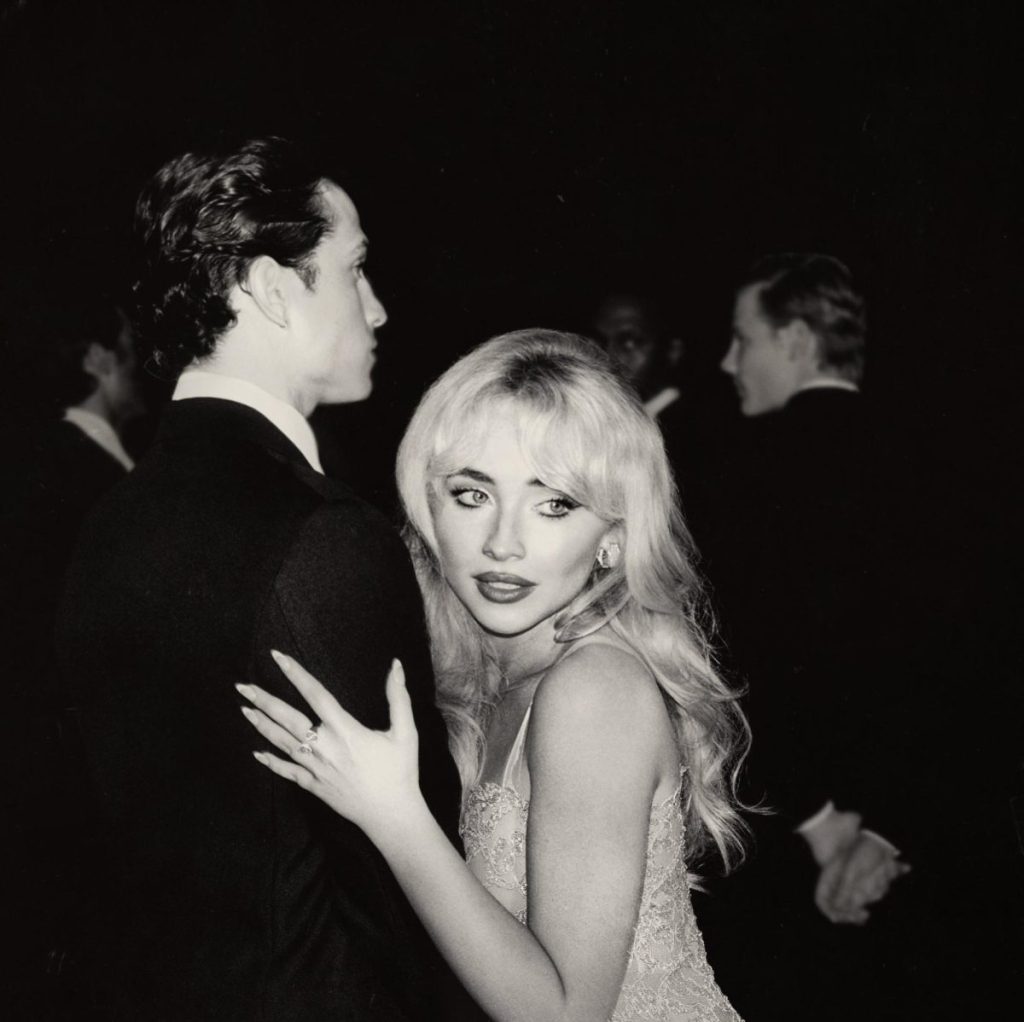
Best-selling pop artist Sabrina Carpenter released her seventh studio album, Man’s Best Friend, on Aug. 22, 2025, sparking widespread debates about what’s considered ‘appropriate’ for a female artist. Much of Carpenter’s global success has been wrongly attributed to her attractiveness, critics claiming she ‘uses’ her body for fame. On the contrary, longtime fans know Carpenter’s work is far more than her physical image. Carpenter has been producing albums since 2015, her popularity finally skyrocketing with emails i can’t send fwd: (2023) and Short n’ Sweet (2024). Her performances are unapologetically playful and sensual – her costumes embrace femininity, and her lyrics lean into wit, irony and double entendres that define her charming popstar persona.
On June 11, 2025, Carpenter released the eagerly awaited official album cover of Man’s Best Friend, causing outrage and discourse on how ‘inappropriate’ and ‘vulgar’ it was. The cover depicts Carpenter on all fours, a large smirk on her face and her hair gently pulled by a man off-frame. To critics on X (formerly Twitter), Carpenter singlehandedly set the feminist movement back by centuries. The album cover was torn completely to shreds, criticizing her role in feminism, the music industry and her personal identity. Yet others read the cover as deliberately satirical, poking fun at the way women are objectified and judged no matter what they do. The backlash against Carpenter exposes a deep-rooted truth about the music industry: for women, perfection is unattainable.
At the album’s core, Man’s Best Friend isn’t about her seduction or shock value. It’s about the humility and chaos of womanhood. The album embraces the idea in a humorous way that women are allowed to make mistakes, fall in love with the wrong guys and laugh at themselves once it’s over. After all, its lead single is literally titled “Manchild,” taking direct aim at male immaturity — hardly a plea for male approval. Carpenter has made it clear she’s in on the conversations surrounding the album and her public image. In a CBS Mornings interview, she explained, “My interpretation [of the MBF cover/album] is being in on the control, being in on your lack of control and when you want to be… I think as a young woman, you’re just as aware of when you’re in control as when you’re not.” Through her perspective, the Man’s Best Friend album cover becomes less an act of male-centric submission and a form of satire — a self-aware acknowledgement of her choices and a pushback on what audiences say about her image. Carpenter isn’t oblivious; she’s participating knowingly, even if that invites misinterpretation.
The backlash against Carpenter mirrors the experience of countless female artists, often including the biggest names in music: Britney Spears, Madonna, Taylor Swift, Rihanna, Christina Aguilera, Beyonce and plenty more have all faced relentless criticism throughout their careers. Ultimately, there is no form of fame or femininity that will satisfy everyone. Women who embrace their sexuality are labelled attention-seeking and insecure; those who don’t are called boring and inauthentic. Women who write about heartbreak are unoriginal and overly emotional, but women who write about other aspects of their lives are unrelatable and emotionless. These criticisms are nowhere near new — women are expected to make breakthroughs in self-expression, only to be condemned upon doing so.
There is a cultural obsession with controlling how femininity is performed, especially in music. People want to see a confident, powerful female musician, but only in the invisible confines of what they’ve decided is okay. Once those boundaries are crossed even the slightest, the public decides it’s gone too far. Carpenter’s album and cover simply made this pattern impossible to ignore. By exaggerating the perceived lack of control — satirizing both herself and the industry — Carpenter highlights the absurdity of these expectations.
Man’s Best Friend is a five-star pop album. It’s such a fun listen, layered with addictive melodies and relatable (sometimes messy) experiences of girlhood and romance — being turned on by the bare minimum (“Tears”), suddenly-distant boyfriends (“My Man On Willpower”), realizing “maybe I am the problem…” (“Don’t Worry I’ll Make You Worry”), to perhaps letting a little too loose after a breakup (“Go-Go Juice”) and then rediscovering yourself (“House Tour”). The public desires to see confident and powerful women — but only those fit into inexplicably defined limits. This is the double standard women have to grapple with daily; no matter what they do, there will always be a critique, and in that sense, women will never truly win. Carpenter handles this with grace and emphasizes this notion to her advantage. Man’s Best Friend balances the world’s expectations with her own acts of self-awareness. By being in on it, she reclaims her agency in an industry where she is always doing something seemingly wrong. If women are always going to be scrutinized, Carpenter’s response is simple: screw it. Why try to fit the mold when her image is bigger than ever? Man’s Best Friend proves that maybe imperfection is exactly the point, maybe being too much is exactly what we as an audience need, and maybe that’s a success only women can achieve.

 UF PRISM