
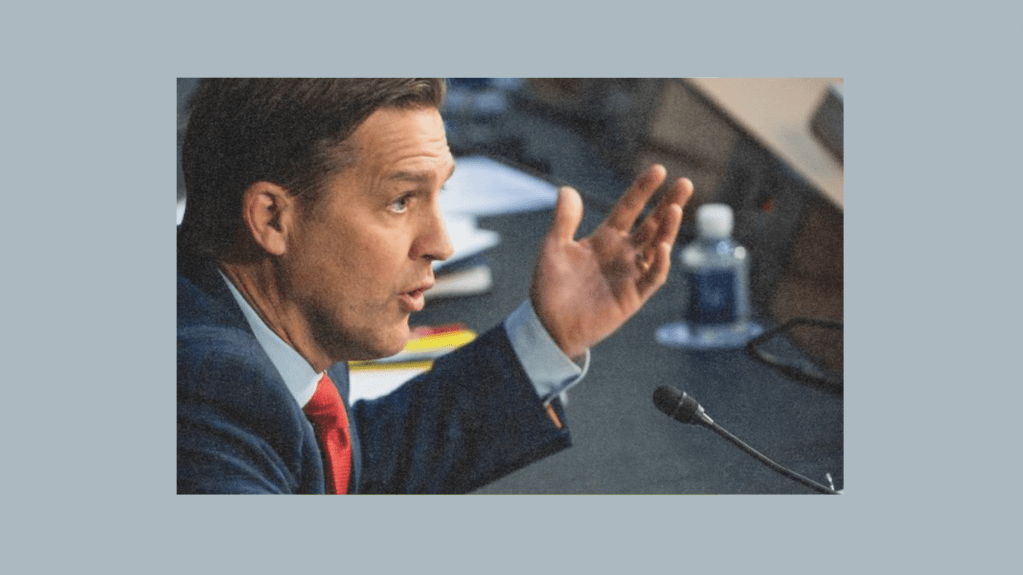
The past few years have been filled with many twists and turns, from the COVID-19 pandemic to new major global conflicts to the rise of accessible AI. Life at UF has been no different: last autumn, former President Fuchs announced he would be leaving his position at the end of the calendar year, heralding a new era for the university as it navigates its course to the top of US college rankings. In has come the unanimous recommendation of the Presidential Search Committee, former Republican Senator of Nebraska Ben Sasse. With a starkly different persona on campus from the fun-loving, interactive Fuchs, Sasse has largely remained a reticent mystery, trekking to Tigert Hall in the predawn hours of the morning and eluding media and students alike. Despite it being early in his tenure, the dearth of a visible presence like Fuchs in the presidency has been unsettling for some, and many wonder about the potential impacts of having a politician in a nonpartisan office.
Sasse grew up in rural Nebraska and excelled in his high school studies, which earned him a ticket to the Ivy Leagues. According to his Senate page, Sasse received his B.A. in government from Harvard, his M.A. from St. John’s College in Annapolis, and his Ph.D. from Yale. Brittanica states that he has held numerous important government positions in the Bush administration, including roles in the Departments of Justice, Homeland Security, and Health and Human Services, as well as spending time at a consulting firm. Sasse does have some experience in university administration: before becoming a senator, he briefly taught at the University of Texas and was president of a small liberal arts college in his hometown.
Sasse’s Senate career was starkly conservative with a ranking of 94% from the American Conservative Union’s Center for Legislative Accountability. According to the nonpartisan research organization Vote Smart, Sasse spoke out against pro-choice court rulings, voted in favor of reducing corporate taxes, and made a major commitment of opposing the Affordable Care Act and expansions of social security and other services during his Senate tenure. However, he was one of seven Republicans to vote to convict former President Trump after the January 6th riots and has called the current GOP out for its “weird worship of one dude.”
Regardless of his politics, Sasse has proven his integrity as a scholar and politician and is clearly educationally qualified—but is he really the best choice to be heading a major research institution like UF, where his constituents will not be voters, but thousands of diversely opinionated university students who did not elect him?
It is hard not to be reminded of the Ron DeSantis-driven overhaul of the Board of Trustees of New College, a small liberal arts college in my home county of Sarasota. It used to boast a “Public Ivy”-level education and an unorthodox curriculum famously devoid of traditional grades for its eccentric student body. However, last January, the governor appointed six new conservative trustees to the college’s board, many of whom were from outside the state. Furthermore, New College’s now-former president Patricia Okker was ousted after denying that “we are indoctrinating students here,” and former Florida House Speaker Richard Corcoran was swiftly chosen as her interim replacement. His political credentials won him the permanent position in October against his two opponents, a surprising result given that both of them have more academic experience and qualifications than Corcoran, according to all three CVs.
In the first board meeting with the new members, of which proceedings were recorded by New College’s Catalyst student publication, the new board pledged to overhaul Diversity, Equity, and Inclusion (DEI) programs, with trustee Mark Bauerlein calling them “coercive and oppressive.” In fact, the New College website now confirms that the Board of Trustees has voted to “terminate” the Women and Gender Studies program, “beginning with the 2024 enrollees.” Clearly, the dismantling of the critically diverse curriculum is the direct result of New College’s new board—is it, then, a coincidence that the college has fallen 24 spots on the US News 2023 rankings, down to a #100 tie among liberal arts schools, from its coveted position as a Public Ivy?
Of course, Sasse is not directly affiliated with the state government, nor should anyone accuse him of being so. However, the former Senator has repeatedly gushed about Florida’s merits, calling the current state of affairs a “glorious moment for the state” in an interview with NPR’s Stephen Inskeep—this statement comes directly within a moment dominated by the passage of exclusionary measures by the state legislature such as HB 999 and SB 266, which prohibit “advocat[ing] for” and spending on, respectively, “discriminatory initiatives” like DEI programs, as stated by the Governor’s office. His implicit acceptance of, or perhaps even admiration for, the state government’s controversial intrusion puts him at odds with many of his new constituents who oppose his conservatism. Returning students will remember the uproarious protest last October against Sasse’s mysterious unanimous recommendation, and the opaque shroud obscuring his selection process (driven by UF’s similarly DeSantis-supportive Board of Trustees). Now that the reins of the Swamp, a major public research institution and arguably the flagship of Florida’s higher education, has been seized by a career politician—especially one with no personal connection to the state—it is only natural to fear that partisanship will soon bleed from the wound Sasse’s election has slashed upon university tradition.
Sasse has been a ghost on campus thus far, perhaps due in part to the heavy criticism he has faced from the student body. People have plastered demeaning stickers around campus, some comparing the former Senator to the corrupt and authoritarian Harry Potter character Dolores Umbridge, and others declaring him “MISSING: Have You Seen This Man?” Even his daily appointment logs, made public record by a Chronicle of Higher Education request, are cryptic, with hours-long blocks simply labeled “Calls.” His public actions have been limited to things like negotiating faculty governance, according to Garret Shanley of The Alligator; his platform has been vague, with his initial letter to faculty focusing on “engaging in ideas,” data, AI and pre- and post-graduation opportunity. However, all of this was before Sasse’s inauguration on November 2nd; now officially UF’s 13th president, will he begin to raise the powerful voice of his position beyond a spectral whisper?
Sasse was lauded as a “unique” and “outside-of-the-box” choice by Chairman Mori Hosseini during the ceremony, and his much-maligned unanimous selection was doubled down on as “exactly the right choice.” Donning a “Beat Arkansas Razorbacks” shirt under his ceremonial robes, Sasse portrayed himself as an everyman in his speech despite his Ivy League education and nationwide importance; he was candid about his nervousness and delivered clumsy jokes to the silent University Auditorium audience. Some platform “appetizers” Sasse provided insight on were striving to make “practical majors more practical” by engaging STEM students with the humanities; focusing on fast and competitive faculty hiring; expanding the quality and quantity of the curriculum; and introducing new study abroad, internship, and “more excellent” research opportunities for students.
His speech contained many remarks that seemed to allude to the crusade on alleged liberal indoctrination perpetuated by Florida’s republican leadership. He pledged for the university to “challenge orthodoxy,” “embrace inquiry,” and strive for “big-hearted disagreement and open dialogue;” as a listener who is fairly familiar with his politics, I was particularly alarmed by his statement that “as a nation we need to do better … the imperialism of mental health categories as superior to moral categories has very likely led to a worsening of mental health” and what that might imply in regard to gender and sexuality. However, Sasse distinctly stated that “a university is not in the business of advancing either a theology of the right or a theology of the left…we’re in the business of teaching people to be more curious…and solving more problems.” It remains to be seen if he will live up to his words, or if this is a disguised threat against the diversity and inclusion his contemporaries have rallied against.
Sasse has a clear commitment to making Florida the nation’s highest-caliber public research institution, and he is particularly knowledgeable about the technological advancements future graduates and workers will need to navigate. The former Senator brings valuable experience in navigating politics in a time of intense and polarized upheaval, and his bold goals for the university imply a term filled with tangible action. However, students concerned about his conservative ideology and potential participation statewide exclusion of diverse viewpoints in education may hope that he remains an invisible enigma.
Featured Image Courtesy of The Washington Post

 UF PRISM